Our management decision tree shows that leaving at least some native ash trees untreated and uncut is a highly constructive management response that enables detection of lingering ash, and should be taken into account when crafting management strategies. In deciding whether trees should be treated vs. cut vs. left for mortality monitoring and/or lingering ash detection, we suggest that you evaluate them with respect to the following factors:
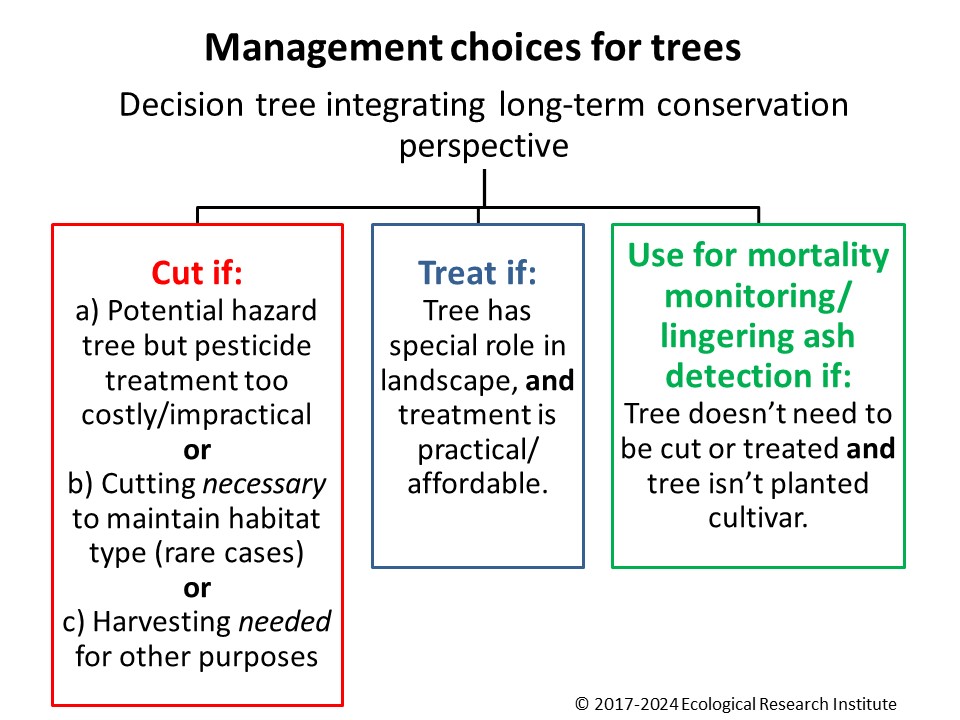
- Are the trees native and naturally occurring? If instead they are planted trees that are either non-native species or horticultural varieties, they won’t be useful for mortality monitoring or lingering ash detection; thus cutting or treating the trees won’t interfere with these objectives. Additionally, in a location with many trees, treatment of a substantial proportion of them may even provide some protection for the nearby untreated trees.
- Do particular trees have particular aesthetic/cultural/recreational value (e.g., landscape design element, historic significance, particularly old or big tree) that could justify treatment with systemic insecticide? To compare the costs of treating vs replacing trees, see the Purdue University’s Emerald Ash Borer Cost Calculator.
- Do individual trees have a particularly important ecological role (e. g., stabilizing a stream bank or suppressing invasive plants) that would justify treating them or mitigating the anticipated impacts from EAB (e.g., underplanting with native shrubs)?
- If considering treating a tree, is it already seriously affected by EAB, which would make treatment success unlikely? If the tree’s crown has shown 50% or more die-back or foliage thinning, then success is unlikely. The less damage that has already occurred, the greater the likelihood of a successful treatment outcome.
- Would treatment be practical for the tree, based on its location?
- Does this tree need to be cut because it is a hazard tree (dead or dying and threatening structures, infrastructure, trails, etc.) or in order to meet harvesting requirements?
- Will the tree be used in a MaMA Monitoring Plots Network plot (in which case, it can’t be cut until it’s dead and can’t be treated) or is it likely to be used for one or more Rapid Ash Mortality Assessments (can’t be cut while live and can’t be treated as long as it’s in use for this purpose).
- Has the tree already been reported and verified as a lingering ash? If so, chemical treatment to enhance its longevity can be helpful.
- If the tree has been verified as a lingering ash, has material already been collected from it for resistance breeding? If so, also, although leaving it in the landscape would be preferable (because it can improve the overall genetics of the population), cutting it is okay if necessary.
- How many healthy mature ash are being left uncut and untreated in the area as a whole? The more that are left uncut and untreated, the greater the likelihood of one or more of them ultimately turning out to be a lingering ash. However, evidence is emerging that treating a sufficient number of ash with systemic insecticides may also provide some protection to nearby, untreated trees. Thus, if the management goal is enabling detection of lingering trees, treatment of any trees in the stand would be disfavored, but if the goal is maximizing number of trees that remain healthy, treating at least some trees could be favored.