How to harmonize lingering ash detection with management approaches to mitigate EAB
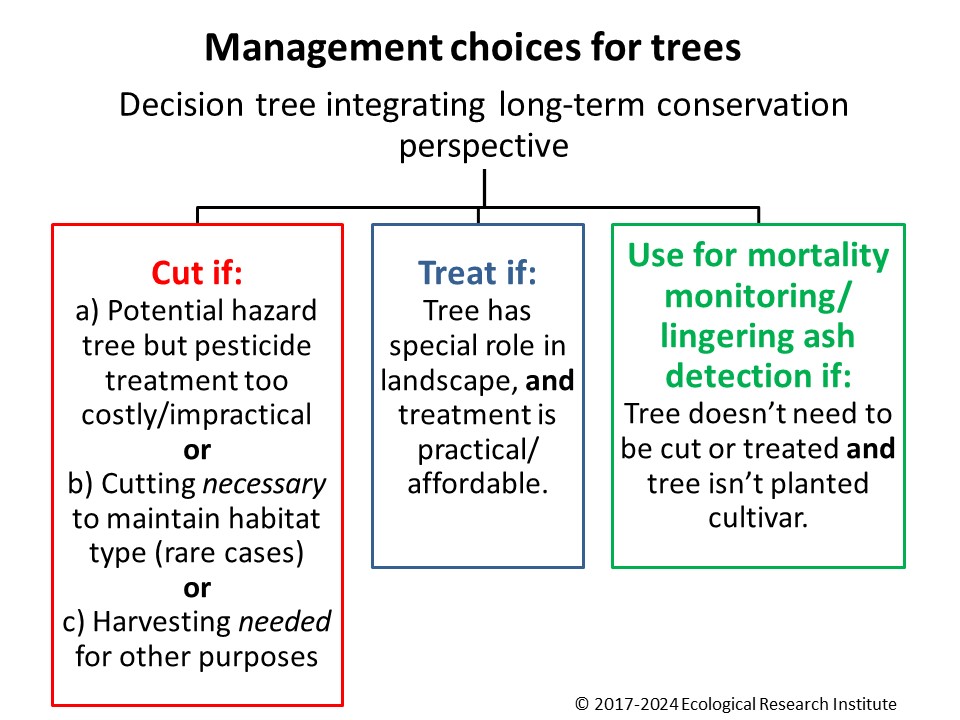
If you are responsible for the management of ash trees, then, in confronting the threat posed by EAB, you will likely have to make decisions about which trees, if any, you should cut, chemically treat or leave both untreated and uncut. As our simplified management decision tree shows, leaving at least some native ash trees untreated and uncut can be a highly constructive management response that enables detection of lingering ash. Here, we explore ash management decision-making more deeply, focusing on how to integrate lingering ash detection into overall ash management strategies, including how it can be harmonized with cutting or chemically treating trees.
If you want to manage your ash to enable lingering tree detection, a threshold question is whether your trees are native and naturally occurring. This is important, because lingering tree detection is aimed at collecting material for selective breeding of native, locally adapted trees. Thus, non-native trees are not useful for this purpose, nor are horticultural varieties. Moreover, in general, planted trees are excluded from this search unless they were grown from wild-collected seeds of known provenance.
If you manage ash stand(s) that are suitable for lingering ash detection, there are two fundamental steps that you can take to help find these trees. One is choosing to set aside some trees that won’t be cut or chemically treated against EAB, so that there will be a chance that one or more of them will ultimately turn out to be lingering ash. This of course means that many of these trees will be killed by EAB, but giving EAB the chance to reveal which trees have substantial resistance can greatly help long-term conservation and restoration. Moreover, chemically treating or cutting all the ash trees in a woodland is often impractical anyway, so planning should be done to decide which trees to cut, treat or to set aside. In this planning, various considerations should be taken into account.
Mortality Monitoring
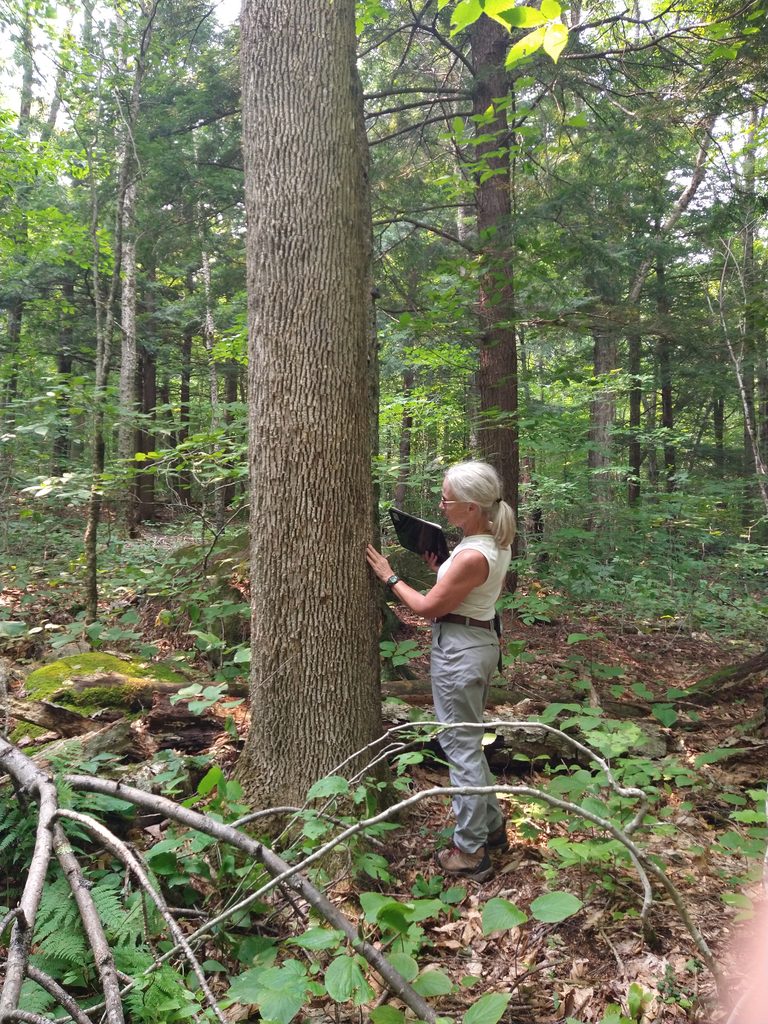
The other fundamental step that can be taken is to conduct mortality monitoring using some of the trees that have been set aside from chemical treatment or cutting. A MaMA monitoring plot just comprises 40 mature (≥ 4” DBH trees, which cannot be treated and cannot be cut until after they die (see MaMA Monitoring Plots Network). These plots can be established either before or after EAB has begun damaging trees, and even after some trees have been killed. Initiating plots before evidence of EAB appears enables documentation of the entire mortality trajectory from its inception until complete mortality, providing important insights into EAB invasion dynamics. However, even establishing plots after some trees have been killed can enable detection of when the 95% mortality level has been reached, and in some cases shows mortality plateauing at lower levels.
MaMA Rapid Ash Mortality Assessments (RAMAs) constitute another, more streamlined (but less informative) way to measure mortality at sites where EAB has already killed substantial numbers of trees. Both plot monitoring and RAMAs help determine when to search for lingering ash in the surrounding areas.
Moreover, monitoring plots can provide managers and objective, quantitative view of the progression of ash mortality on their land. This can be very helpful in guiding ongoing management decision-making and planning because (at least in the case of white ash, for which we have the most data) mortality trajectories can vary greatly between regions and between sites.
Measuring and documenting ash health and infestation status using monitoring plots and rapid mortality assessments also are representative of the crucial role that managers can play in data collection. In addition to this monitoring, managers can also collect and report data on EAB occurrence (in areas not previously reported) early in the invasion process using MaMA Ash/EAB Surveys and also report results of lingering ash searches at late-invasion high-mortality sites using MaMA Lingering Ash Search.
Harmonizing with Chemical Treatment
As mentioned above, management decision-making can comprise choosing which trees to leave for lingering ash detection or instead to treat or cut. Chemical treatment and cutting of ash can each play useful roles in confronting EAB invasion, but each can interfere with and in some cases preclude lingering ash detection. Moreover, each of these approaches has its own limitations and drawbacks, which should be taken into account in deciding whether to employ them.
In particular, chemical treatment is costly and faces logistical challenges in that its most effective application, trunk injection, involves using heavy tanks and injectors that can be unwieldy to carry long distances or over rough terrain; moreover, use of such insecticides can be outright prohibited or environmentally inadvisable in some locations. These factors can significantly limit its use. Additionally, chemical treatment’s effectiveness depends upon the extent to which the tree has already been damaged by EAB prior to initiation of treatment.
However, in the right circumstances, chemical treatment can be worthwhile for trees that are deemed by the site’s managers to be of special importance. These can comprise for example trees that are of particular aesthetic or historic importance or that provide services such as stabilizing a streambank or providing needed shade,
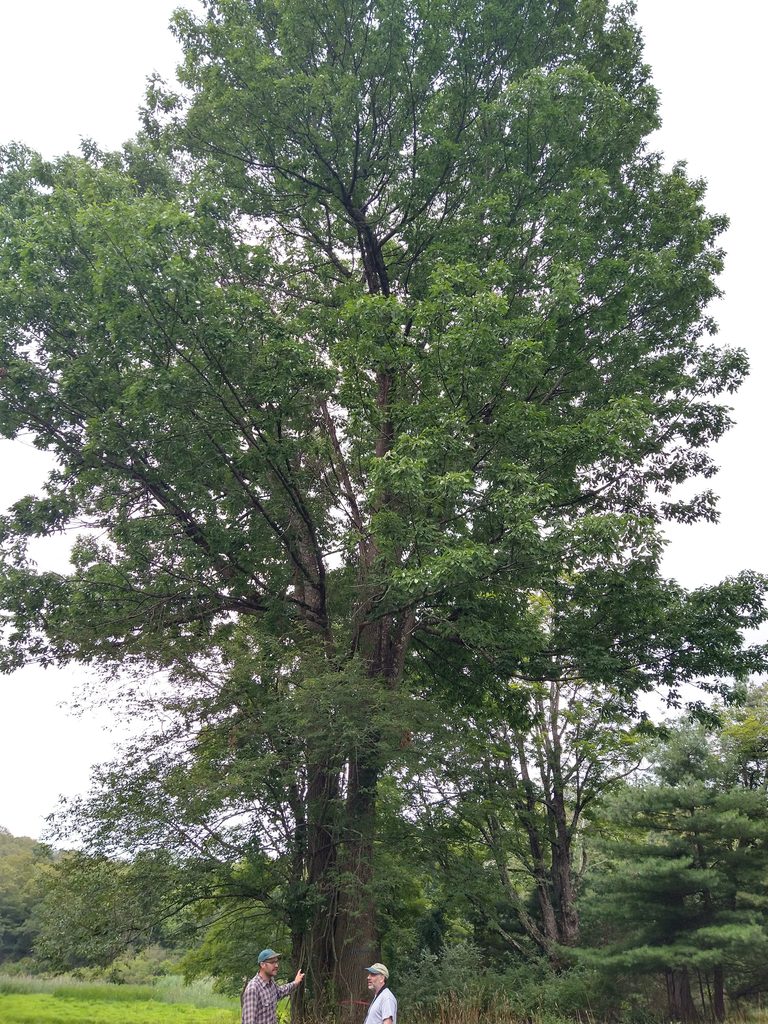
In the case of black ash, chemical treatment can form part of a conservation approach in which the treatment enables the trees to persist and reproduce and thus enable their habitat to persist, instead of turning from a swamp into open water Because black ash faces the most severe impacts from EAB, chemical treatment can also help preserve genetic diversity that might otherwise be rapidly lost.
Some studies have shown that chemical treatment of ash can in some cases affect EAB attack or impacts on not only the treated trees themselves, but also, to a lesser degree, nearby ash. Thus, to the extent that its practical, widespread treatment of trees might benefit additional ash occurring in the vicinity, but the strength of this “neighborhood effect” is not clear and might be quite limited. Also, such an effect could in theory complicate efforts to detect lingering trees, and just to avoid this possibility, we suggest placing monitoring plots at least 100 meters from the nearest treated tree if possible (see Mwangola et al., 2023).
One way that chemical treatment can complement lingering ash detection is for trees, in some cases to be treated after they have been confirmed to be lingering ash. This can be helpful because often lingering tree have only partial resistance and will therefore eventually decline and die from EAB attack. Treating these trees can enable them to persist in healthy condition, serving as potential sources for future collection of scion, seed or pollen. It can also possibly enable them, through sexual reproduction with other nearby trees, to benefit the population genetics in situ.
Harmonizing with Tree Cutting
If lingering ash detection is to be pursued, then cutting must also be harmonized with it. Choosing which trees to cut would of course depend on the management goals – is it to remove potential hazard trees or to realize some income from timber or is it to harvest “basket trees” for Indigenous communities? Is the cutting being considered as part of a silvicultural approach to promote ash regeneration as a step towards conservation? Factors to consider include whether the likely die-off due to EAB will render any efforts to open the canopy to promote seedling growth unnecessary.
Moreover, removing healthy trees for any purpose can promote explosive growth of invasive plants by enabling more light to reach the woodland floor. Although gaps and resulting invasive plant proliferation can also occur simply due to the canopy opening caused by EAB-induced ash die-off; the problem can be more severe following cutting of healthy trees. This severity is due to the fact that EAB takes multiple years to kill ash, and as the ash trees die back, neighboring trees of other species can expand laterally to at least partially fill the canopy gaps. In contrast, cutting healthy trees, especially if they’re large and/or numerous can suddenly open large gaps. This is particularly problematic at sites where invasive plants are already present or where there is a nearby source of invasive plant propagules. One approach that can help limit this adverse impact is to do plantings that can shade the ground beneath the gaps and thereby suppress invasive plants.
Choosing which trees to cut can benefit from some flexibility to reflect knowledge gained as the consequences of EAB invasion of a site play out. Thus, even well before the 95% mortality is reached, if some trees stand out as completely healthy when most trees are dead or severely declining, then we would encourage sparing all of the healthy trees from cutting to see which if any are eventually revealed to be lingering gash.
Along with cutting and chemical treatment, releasing parasitoid wasps has also been employed as a response to EAB invasion. In fact, establishment of parasitoids as effective biological control agents coupled with establishment of native ash with substantial levels of EAB resistance would constitute an ideal outcome, combining to strongly limiting EAB’s impacts.
Harmonizing with Parasitoid Release
For now, however, the question arises of whether parasitoid releases preclude lingering ash detection. Although research has shown some of the parasitoids to have significant effects on EAB in some cases, nevertheless we have observed high levels of ash mortality even at release sites. Moreover, parasitoid releases have been so widespread in some areas that parasitoids are virtually ubiquitous there, so in practical terms avoiding sites with established parasitoid populations can be impossible. Mortality monitoring in such areas is still to be encouraged, because assessing mortality levels should document them as they are, taking all factors into account. Additionally, even in areas with established parasitoid populations, trees with higher levels of resistance are likely to maintain their health longer and be differentiated from the rest of the ash there as lingering trees. Moreover, lingering trees, in environments where parasitoids are exerting pressure on EAB, are likely to maintain their health longer, which is currently being investigated by USFS researchers.
Mwangola, D., Kees, A., Grosman, D., Norris, K., Maddox, M., Aukema, B., 2023. Associational protection of urban ash trees treated with systemic insecticides against emerald ash borer. Front. Insect Sci. 3. https://doi.org/10.3389/finsc.2023.990909